
By: The Library of Babel Group
Date: May 2026
The product of a collaboration between AI-critical university educators in multiple different countries. AI resistance looks different for each of us, and we need each other, in all our diversity. The poems, photographs, illustrations and words each express different forms of resistance to AI in education – open protest, creative reimagining, measured diplomacy, furious defiance, joyous engagement in material work.
Text version (click to expand)
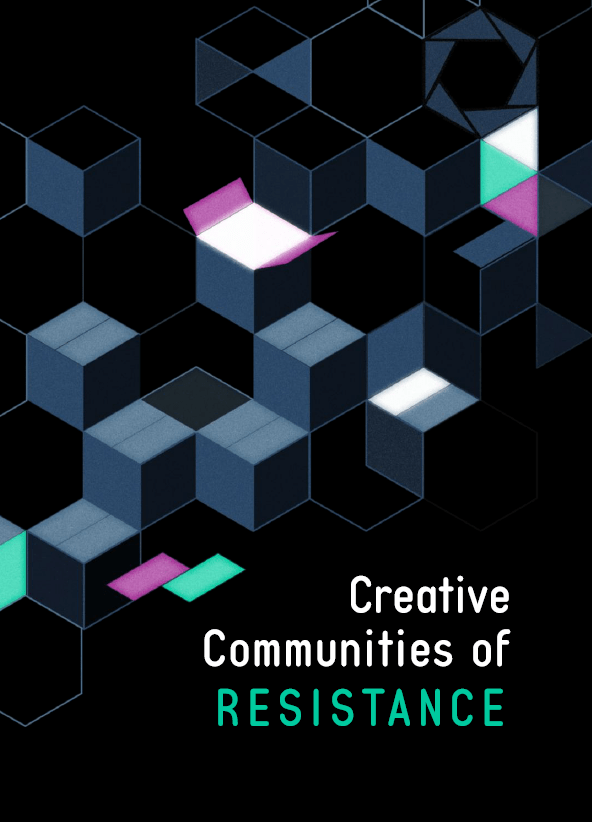
Cover: Creative Communities of Resistance
Image: A pattern of hexagons, some shaped like rows of closed boxes, with others opening at the top or becoming apertures into new kinds of windows.
Inside cover
This zine is the result of a collaboration between AI-critical educators across continents.
Some of the words and images were created by members of the Library of Babel Group. Some were not.
Some were created by outspoken critics of generative AI. Some were not.
All artworks are attributed to their creators.
Page 1
NARRATOR (TO SELF):
We are called to answer the call to resist:
to celebrate community
c. wright mills challenged me to
look at how private troubles became public issues
troubles, issues
connect your biography to history
connect history to identity, to injustice
push back, resist,
write words that change the world
one word at a time.
Norman Denzin, Performance autoethnography: Critical pedagogy and the politics of culture
Page 2–3 How this zine was made: Duoethnography
Life is an evolving curriculum
Our lives have shaped our understandings of ourselves in our worlds. These understandings change over time, through experience, reflection and the relationships between us, which are themselves part of our lives.
Polyvocal, dialogic and open
We will remain explicit about whose voice is whose. The aim of duoethnography is to place multiple, even conflicting, stories in conversation with each other. This includes the stories of readers. We hope that our readers can use our thinking to stimulate their own.
Deliberate juxtaposition of different ways of knowing
Every one of us has a unique perspective shaped by our different lives. We do not aim toward a consensus representation, but to hold open multiple perspectives and recognise that all perspectives are perpetually ‘under construction’.
An ethical stance is a negotiated space
Duoethnographic ethics are inherently relational. We are not participants being studied, but co-researchers negotiating the ethics of this project together; and consent is not a signature on a form, but a continually open question between us all. Limited by time and geography, it is even more critical that each of our choices support a dynamic of trust and safety in working together.
Page 4
The loudest critic
now copyediting the
anthropomophized
hype out of AI news posts.
Kaitlin Lucas
Page 5
Image: A distorted closeup of a mouth, screaming, overlaid with flies, lace and gothic lettering.
Artwork: Dawn Hudson
Page 6
Image: A row of human skulls becoming increasingly distorted by digital glitching and discoloration.
Artwork: Kathryn Conrad
http://betterimagesofai.org CC-BY 4.0
Page 7
I am frustrated by how the ‘AI revolution’ is framed as revealing that everything we’ve been doing in higher education is worthless.
If I hear someone say ‘if an assignment can be automated, maybe it isn’t worth doing’ again I might explode.
The fact that an LLM has scraped enough essays to squeeze out a plausible one is not a reflection on the value of writing.
Kathryn Conrad
Page 8
From: An Open Letter to Georgetown Students, In Response to Recent Announcements by the University about “Generative AI”
I keep looking around in the hopes that someone who is more powerful than I am, whose job is safer, will — for your sake — speak up about what a shameful and embarrassing capitulation this is, and say something about how it connects to the political collapse we are all living through in this country right now. Maybe that will still happen. In the meantime, I want to remind you that the future is yours, and it is not known — not by you, not by Georgetown, not by Sam Altman or Elon Musk, not by the chatbot, not by me. And that is a beautiful thing.
Emily Tucker
Page 9
Image: A line drawing depicting a male professor pouring books from a shelf into the funnel of a machine. Beside him, a student is turning the crank on the side of the machine. The image is labelled ‘A l’Ecole.’
Page 10
Image: A human silhouette, suspended in midair with arms and legs splayed. Dozens of cables with wall plugs extend from the silhouette.
Artwork: Rose Willis
Page 11
But the great thing is
you don’t have to
go along with this
and I urge you not to.
You can refuse to use the chatbot.
You can organize against “AI” requirements
against data products surveillance systems & automation
in all aspects of your university experience.
You can create student groups dedicated to
the rejection of all these things &
to the imagination of
what you would like your
education to be.
Emily Tucker
Page 12–13
I try to take hope and sustenance from experiences that don’t scale up
Image: A photograph of a book of heavy paper, spread open and illustrated with washes and scrawls of ink. A fountain pen with a wooden handle lies across the pages. Above the book is a row of seven bottles of ink, labelled ‘wild blueberry’, ‘sumac + walnut’, bed & breakfast’ and ‘badgers brew’.
Words and art: Kathryn Conrad
Page 14
After screaming into the void and being impatient for immediate change, I’ve realised we need to do that systematic, hopeful and patient work to move forward.
I don’t have that hope nor patience as an individual, but as part of a collective I am gaining the strength for both.
Words: Elisa Bone
Page 15
Image: A poster with the title ‘Boycott A.I @ RMIT Art School’
The poster depicts a stylised robot with its ‘head’ severed, and a screen display on its chest with a sequence of text blocks that read:
Chat GPT
“Can you give me a prompt for my next art piece because I’m incompetent?”
“Of course! It can be hard to think of art projects by yourself, why do anything when I can do it all for you?”
“Thank you. I love having no creative liberty or authenticity in what I do! Smiley face”
Also displayed are:
A bubble labelled ‘Sign the petition’ pointing to a QR code
A bubble labelled ‘Support real art’
An Instagram icon followed by @government_issued_paranoia
Page 16
Image: Indistinct brushstrokes in fiery tones of yellow, orange and brown
“Burn it down” is a call to action as much as it is a plea to have some fun. The robot revolution came so quickly on the heels of the pandemic that I think a lot of us forgot that teaching can be a profoundly joyful act.
Melanie Dusseau, ‘Burn it down: A license for AI resistance’
Artwork: J. M. W. Turner
Page 17
Resistance is not anti-progress, and pedagogies that challenge the status quo are often the most experiential, progressive and diverse in a world of increasingly rote, Standard English, oat milk sameness.
Go wild and assign actual novels to remind students why pleasure reading enhances deep reading, empathy and language skills.
Bring students on board in crafting new, nonpunitive academic honesty policies that admit the truth: We’re all still figuring out the post-plagiarism robot apocalypse.
Stir a little creative writing pedagogy in the mix by asking students to write flash fiction, poetry and oddball micro essays in place of easily chat-produced summary responses to required readings.
Teach like the institution’s disintegrating, the grid’s going down and the oral tradition is about to make a surprising, musical theater–like comeback.
Continue to bring the funk, fun and ambrosia salad to the human party—and never say sorry that it’s nostalgically kitschy, unapologetically weird and made by your own hand.
Melanie Dusseau
Page 18–19
Image: A collage of words and letters from assorted magazines, arranged to form a poem:
If learning is just
A question of efficiency
Publish or perish
Success
Productivity
Of course
We submit to AI
We need a revolution in our thinking
Resist the hype
Resist the heist
Every person deserves to experience
Detours through I don’t know
& wrong
& to explore winds that blow blossoming wonders.
Clare Kelly
Page 20
Image: A row of newspaper headlines reading:
The train has left the station
The genie’s out of the bottle
The toothpaste’s out of the tube
The horse has bolted
The cat’s out of the bag
The ship has sailed
Below lies the ocean. On the horizon between sea and sky, a trail of smoke can be seen following a ship sailing out of the edge of the image.
Under the water, a whale swims downward into a lively ocean, populated by many forms of fish and plant life.
Artwork: Miriam Reynoldson
Page 21
Maybe we’re at an extreme point where we have to go all in on what we really believe education should be about. Maybe we have to find each other outside these spaces and start to build what we think is a real form of education, even if they’re small and parallel for the time being, and face up to the idea that the system that we are currently working in simply needs to be replaced.
– Dan McQuillan
Page 22
‘…the rapid response of the AI offers a speech without silence, without stutters or pauses, save the temporary flickering of the cursor as the fluent response is marshalled. Perhaps it is the empathy and compassion of listening, the stuttering difficulty of finding the right words, the distinctive shape of our silences as we struggle to birth new thoughts into language, that is demanded of us in a world where our machines can produce endless text at the speed of thought (or faster).’
Keri Facer, ‘Beyond voice: listening and silence in climate change education’
Page 21
The day you were made
I gave my most rehearsed talk.
Ten minutes to frame
G-P-T as a cipher:
decrypt Mechanical Turk!
From two tiny cells
to the baby in my arms,
We laugh together
at the tech bros’ great hubris:
‘you say intelligent what?’
Sleep-deprived mother
comments on model collapse.
Microphone shaking
during Gary Marcus’s
‘esteemed’ guest speaker visit.
Returning to work
transformed nine months post-partum.
Maternal reprieve?
Unpolished technologist
back into the fighting ring.
Kaitlin Lucas
Page 22
“Here”
is no more (and no less) than
our encounter
and what is made of it
Doreen Massey, For Space
Image: Closeup of a hand brushing through a few stalks of long grass.
Back cover
Library of Babel Group
 The Mind File