
Why it matters
Most courses of study today are required to be based on learning outcomes, learning objectives, aims, goals, intentions, or some set of specified, hoped-for results. In accredited courses, these are mandatory and must meet accreditation standards. In workplace training and other non-formal learning, they are expected practice.
I’ll call them learning outcomes for now, but these principles apply across the board. It’s just the level of detail and complexity of learning that will vary depending on the type of course, the length and nature of the learning.
Defining learning outcomes will give you the scaffold you need to design your entire course. They are the basis of constructive alignment (the alignment of learning outcomes, assessed activities, learning activities and the environment in which learning takes place).
Anatomy of a learning outcome
There are, essentially, four parts to a learning outcome: (1) the stem, (2) the verb, (3) the content, and (4) the context. Here’s what this looks like.
By the end of this course, you will be able to:
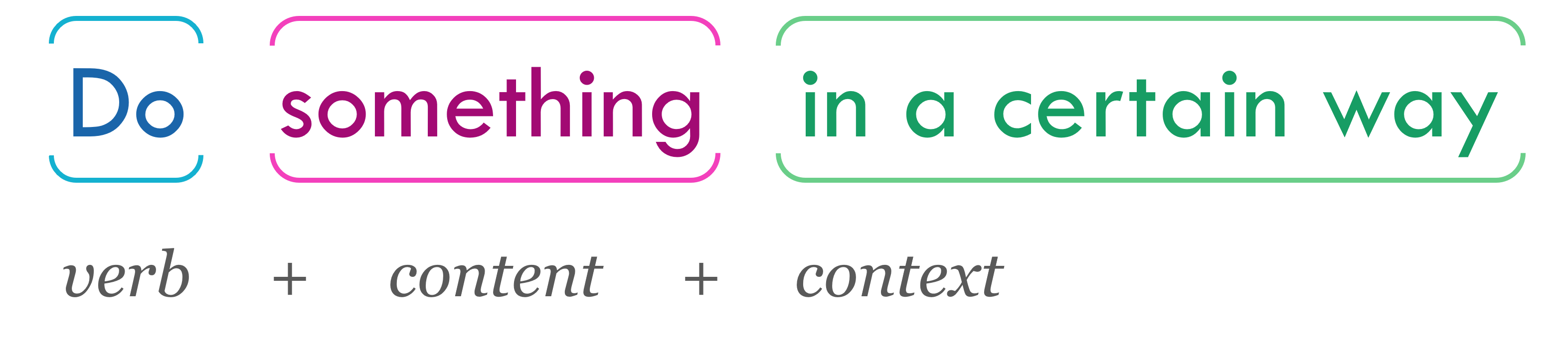
Let’s break it down:
Stem
This is the lead-in phrase that frames your learning outcomes. It usually looks something like “By the end of this course, you will be able to”, or “Upon successful completion of this completion, graduates will be able to”. Put very simply, it should clarify at what point the learning outcome should be achieved.
Verb
This needs to be a tangible, measurable action that the learner will be able to take. Avoid cerebral, hidden verbs like “understand”, “know” or “be aware”. These might be things you want the learner to achieve, but the verb has to be define how they will demonstrate it. For instance, to check someone’s understanding, you might ask them to explain.
If you feel compelled to use more than one verb, it is most likely that you actually have two learning outcomes. Each learning outcome should lead with only one verb.
To choose a suitable verb, you might consider models like Bloom’s taxonomy or the SOLO taxonomy. Both of these use a hierarchy of increasing complexity and challenge, and offer a range of measurable actions that could be used to start off a learning outcome. The more cognitive complexity involved in the action, the more suitable your outcome will be for higher levels of learning (think undergraduate, honours, masters, and so on).
Let’s go with “construct”. It sits at the top level of Bloom’s (the “Create” level), and suggests the learner will be putting something together from the resources they have.
Content
This is the topic — that is, what the learning is about. Times tables, international policy, nutritional science, whatever. Make sure you name the content specifically enough that it, too, is measurable. “Recall the times tables” just needs a bit of scoping (there are, in theory, infinite times tables) so that the learner, and the assessor, will know when the outcome is met. “Recall multiplication facts of two, three, five and ten” puts a neater boundary around this topic.
Obviously our topic is learning outcomes. I’ll go with “measurable learning outcomes”, to clarify we’re talking about constructing outcomes that can be assessed.
Context
This part of the learning outcome refers to the situation in which the noun must be verbed. Provide a concise picture of the circumstances or specifics in which learners should be able to perform the action. It might be…
the necessary constraints (e.g., “within a limited budget”)
the standard to which the action should be performed (e.g., “to a publishable standard”)
the environmental or social context (e.g., “for a public health provider”)
what strategies the learner should use (e.g., “using efficient mental, written strategies and appropriate digital technologies”)
the stakeholders, clients or collaborators (e.g., “for an audience of executive decision makers”).
For the sake of this exercise, I’ll use “an undergraduate university course” as the context of our learning outcome. Here it is put together.
By the end of this article, you will be able to:
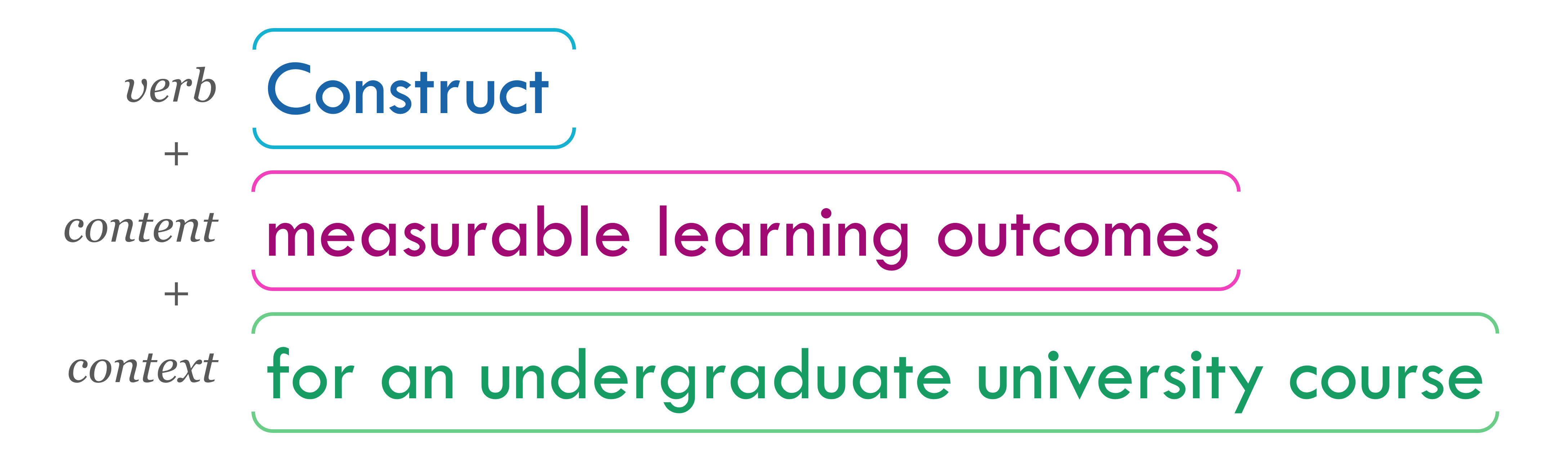
This makes it seem simple — of course it’s not simple. Learning outcomes are a constant game of second-guessing ourselves. We don’t want to be so broad that every person who reads the outcomes will interpret them differently, and we (usually) don’t want to be so specific and granular that there is no room for learners to discover new potential through their learning.
You’ll know you’ve got a good learning outcome when you can think of more than one solid way to assess it. If there’s literally only one possible way, then it might be too granular or too specific. If it’s hard to think of any assessments at all, it might be too vague or broad.
Most importantly, keep practising. This is one of the most powerful tools in any educator’s toolkit.


 The Mind File
Leave a reply to juliannewmanymailcom Cancel reply