
I finally made it to the Peer Revue, an improvisational comedy show where academics from various disciplines hand their research to an improv troupe to be reimagined in absurd and playful ways.
The Peer Revue is an improvisational comedy event produced by the assessment researcher Professor Phillip Dawson, and this month Phill himself put his own feedback research under the spotlight. So I had to see it.
I’ve been meaning to go for a long time, but despite never having been before, I already loved it.
Why?
Because in contemporary times, Being An Academic is a very serious game. It has rigid public performance requirements: you represent both your own disciplinary brand and the brand of your university, both of which are jealously curated. Your public reputation is essential to your ability to win grants, and winning grants is essential to your ability to do research, which is, well, your whole deal, really.
So there aren’t many outlets for academics to play like this.
And play is a precious thing.
Playful academics in a game world
Games are everywhere in life. What is a game, but an interconnected set of pre-determined rules and structures that constrain our options for achieving an externally-defined winning condition? Save the princess. Get the bonus. But you have to wear the right uniform, read from the script, and remember, you can only move up-down left-right.
Improv is play, but I don’t think it’s a game. There are rules and structures, for sure. But improv rejects predetermined anything. One of the rules is that the rules can change in the moment. Play like this enables us to imagine the extensions, the opposites, the otherwises of our lives, and to subvert the normally-fixed rules of the game. Winning is not the point or even possible. It’s all about discovery, shared sense-making, shared mess-making.
Improv is funny — but it’s also nerve-wracking, because it could go anywhere. Audiences know this, so they’re not exempt from the knife’s edge. Just watching can be terrifying (my friend, who came with me, said she was cringeing throughout).
We all play our games so intensely each day that improv theatre, for most of us, is an unthinkably frightening activity.
I’m guessing not every academic that stands up at the Peer Revue is brave enough to participate in the improv act. Phill did. He leapt in gamely (and skilfully!) and built on the troupe’s imaginings of his work, playing on tropes of teaching, research and the academy.
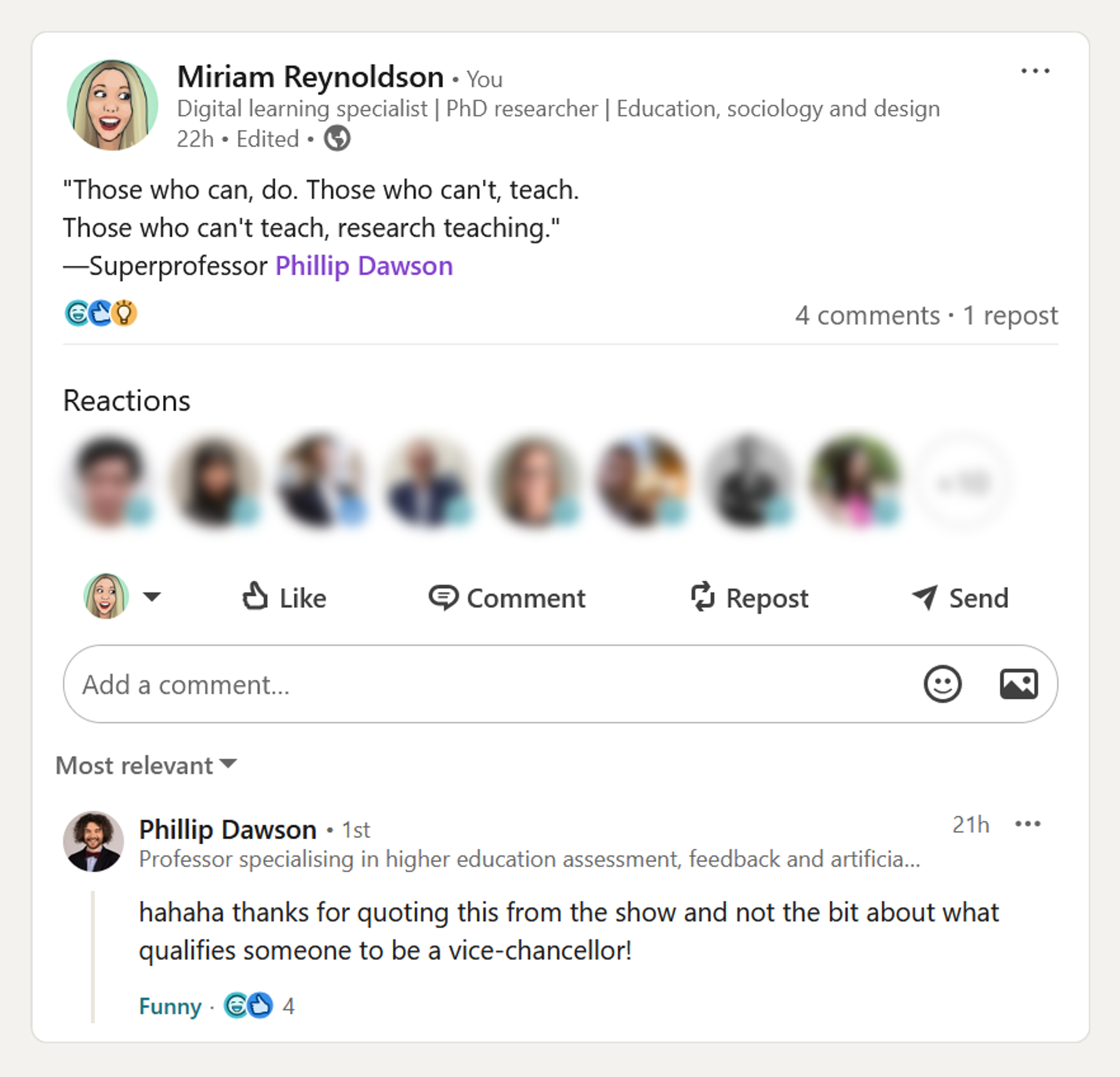
I hope to be such a playful researcher. (I won’t say academic… I’m not sure I ever want to embrace that identity!) It’s a very difficult thing, as an adult, to poke fun at the serious games we play. It’s far, far more difficult when everyone is watching, and when we badly need the world to believe in what we do.
But I believe the academy needs play. Otherwise, it’s all performance.
New article alert!
This week, Sociological Review Magazine will publish a piece I’ve written about the role of play in a game world. I’ll post an update when it’s released — it’s open access, informal and very short.
If you’re interested in play, games or academic identity, I’d love to hear what you think!
 The Mind File
Leave a comment