
Last week I had the privilege of speaking at Education after the algorithm, hosted at Dublin City University by one of my digital education heroes, Eamon Costello.

More about the conference: Education after the algorithm: Co-designing critical and creative futures
I have lately been exploring ways of fostering hope in the face of an increasingly dystopian present. I’ve always been a cynic. I’ve lived with depression for decades. And now the world around me is burning in so many different ways at once. Rather than surrender to my natural doom-heavy reaction, could I possibly choose hope?
So in this talk, I simply aimed to show how the tidy strategy of scalable algorithmic education is no match for the infinite complexity of lifelong, lifewide learning. I presented on the wild web: the messy, rich, diverse and unquantifiable mess of learning relationships that we collectively create as we learn throughout life.
An algorithmic web
These are the algorithms I see creating a satisfying, seemingly self-contained model of lifelong learning in an age of AI:1

The predictive algorithm determines the lifelong learning curriculum (here represented by a list of “future skills” drawn from OECD’s Future of Jobs report).
The generative algorithm produces pedagogical content for our consumption.
And through surveillance and learning analytics, our performance is monitored, assessed and course-corrected to ensure we are continuously learning on the paths set out for us.
I’m not critiquing this thing. I don’t need to. It’s already in place and has been for years; the only new part is the sophistication of the generative bit, and doubts are mounting there as GenAI developers consistently fail to deliver on their impact promises. Otherwise, this is the managerial education landscape in which we already work.
Instead I just tried to describe what lifelong learning looks like from my position so far. It’s not tidy. It’s not linear. It doesn’t work in predictable ways, and it does not scale in any way that benefits revenue projections.
A wild web
Learning across the length and breadth and depth of life is messy, plural, layered, intersectional. It doesn’t end, and it doesn’t start, and nobody is ever just one thing at a time.

In my presentation I tried to draw this multiple times. I drew a spiderweb, a page full of squiggles, a crosscross of intersecting and contradicting arrows along a lifeline. They’re all terrible representations and I think that’s because this is a thing that can’t really be captured. I think we all create so much “data” that it would confound any algorithm. I think from our deep-held dreams to the chances we catch on the wind, all our learning creates value that cannot be quantified. And when the community is the curriculum, we each have the agency to be teachers ourselves and to contribute to the wild web.
The only thing stopping us is our belief in ourselves as agents. The more we attempt to scale, the more agency we give up in service of efficiency, consistency and predictability. Never forget that “prediction” is not the mere calcultation of chance, but an exercise in managing and minimising it.
Last week, another of my digital education heroes, Tim Fawns, pointed out that when learning analytics are used to flag a student as “at risk of failure” and trigger interventions to correct their progress, they are not merely predicting that student’s future, but changing it. This can certainly be helpful, but it also codes certain ways of existing as problems to be eliminated.
We don’t have to accept the codes imposed on us and on those who learn with us. There are so many other things that we are and can be.
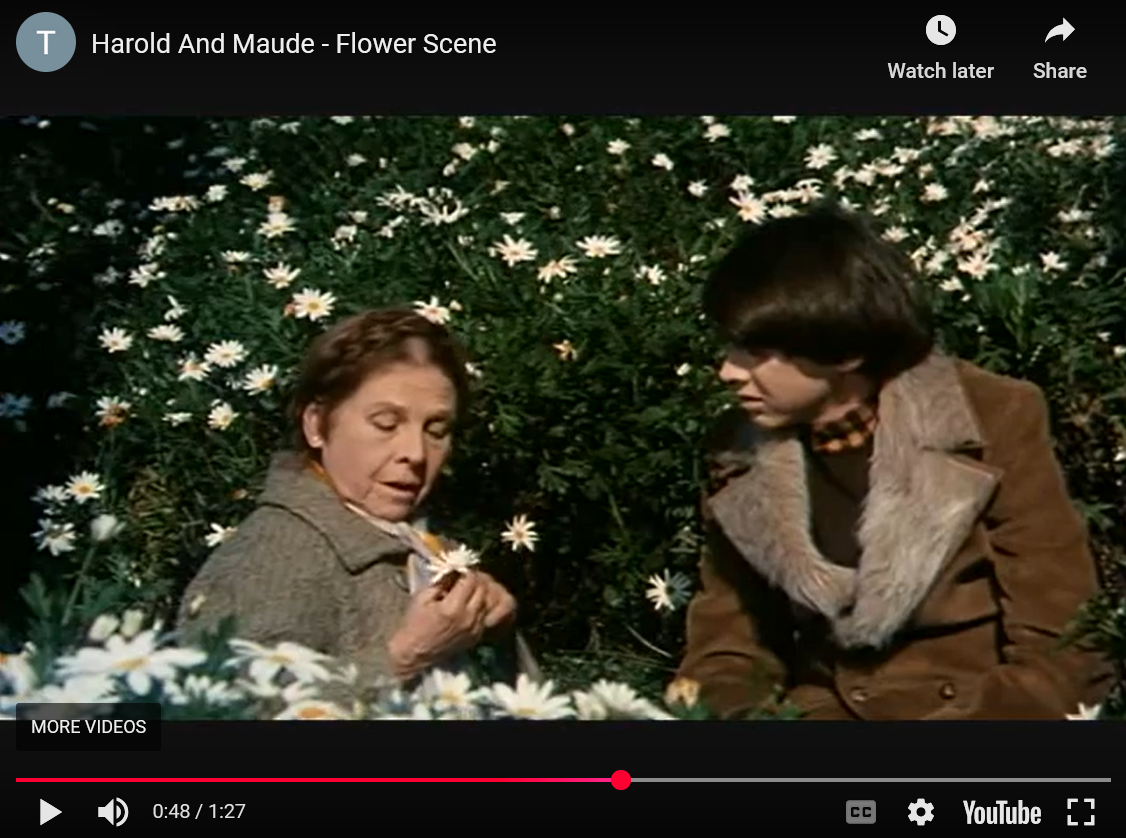
Take a moment to watch this wonderful, tiny moment in the 1971 movie Harold and Maude. In this unhinged little film, Harold is a morose young man whose staged suicides are the only means he has of getting any reaction from his wealthy mother. He falls in love with 79-year-old Maude, who shows him how many other ways there are to live.
A note, so you don’t mistake me: algorithms aren’t exclusively AI models. They’re not even exclusive to computer technologies. An algorithm, plain and simple, is a set of rules to be followed in an operation. An emergency evacuation procedure could even be described as an algorithm. Formal education has been algorithmic for a very long time.
 The Mind File
Leave a comment