
More about neurodiversity and whether and when labels are helpful
My recent post about labels like autistic, neurodivergent, queer, etc. was prompted by reflection about how many of the friends I’ve made over the past decade or so have been diagnosed, self-diagnosed, or questioning neurodiversity.1 It was inevitable that I make a connection between this and my experience about two decades ago when so many peers were doing the same — except regarding sexuality.
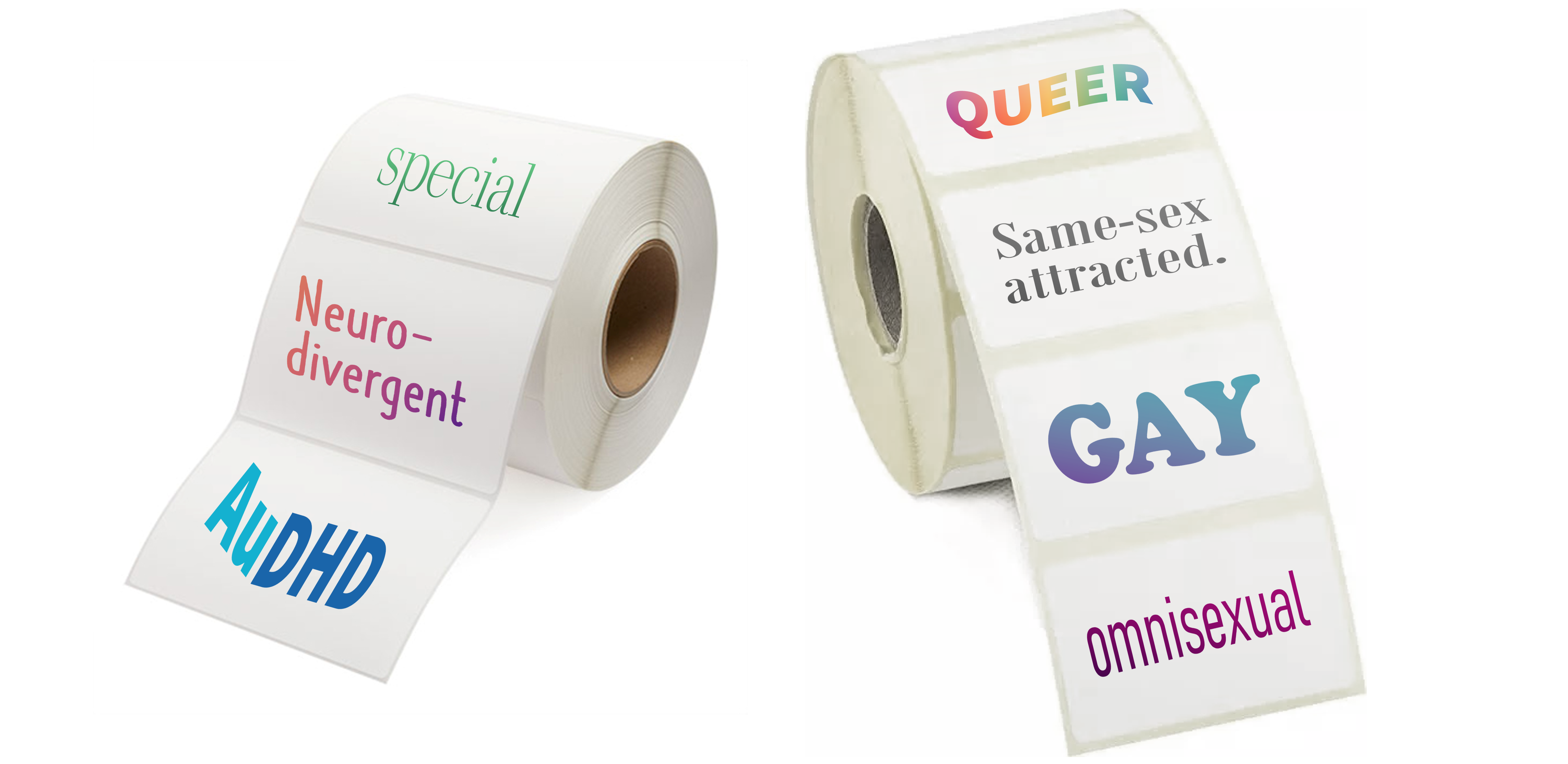
You might argue that the two (queer, neurodivergent) are different, but the more I consider this, the less different they seem to me.
Being queer isn’t a medical diagnosis? But it used to be.
Being queer doesn’t require therapeutic intervention? No, not always, but LGBT+ people experience significantly higher rates of mental distress.
Being queer is an identity, not a pathology? Well, this is the point I was trying to refute, poorly I think, in my other post.
Fundamentally, I don’t believe our biomedical or psychological instruments are near sophisticated enough that our neurodivergent categories are an accurate inventory of human experience. We know “autism” is actually a vast spectrum of different conditions impacting social and sensory functioning. The diversity of manifestations of autism has led far too many people to imagine the “spectrum” is actually a gradient of “very autistic” to “a little bit on the spectrum” (yes I am cringing as I write this). We know that, like autism, ADHD manifests in significantly different ways in children, adults and people of different genders. Our knowledge of autism biomarkers2 is still tenuous at best. These two3 conditions are the headliner conditions for neurodiversity, but of course various others are often included, like learning disabilities and mental disorders.
It’s my prediction that many of these diagnosis labels will disappear from our diagnostic manuals in years soon to come. Some will be renamed, replaced, revised; some will be combined, expanded, or simply removed. Fifty years ago, autism was a considered a type of schizophrenia. My own original diagnosis of dysthymia no longer exists, now replaced in the DSM-5 with Persistent Depressive Disorder. Stuff changes. What the doctors say changes. Our experiences, though, remain themselves.
That doesn’t mean throw the labels away. They are the best we have right now for helping us understand one another and ourselves. They the best we have right now for getting urgently-needed resources and support. But it means, in the words of a wise former boss of mine, we must hold them lightly in our hands.
We just have to remember that labels are helpful until they’re not. Take ASD. “Spectrum” stops being helpful when people started saying “we’re all a little bit on the spectrum”. “Disorder” stops being helpful when an autistic person no longer sees their identity as “disordered”, but simply as different. Right now, “autism” is a helpful word. Maybe, one day, it won’t be.
A final note on that word “disorder”. It’s not always useful, but it’s important. For some, autism always remains a disorder. For others, it’s fluid. For me, depression is a disorder when it prevents me from being able to live a life that is normal for me.4 And you know, it is possible for a neurodivergent person to live a normal life. Not normal for you — normal for them.
I know — birds of a feather flock etcetera. I have always been, uh, eccentric, but whether I am or am not on any “spectrum”, I’m not personally interested in seeking a diagnosis. This isn’t because of any stigma but because I believe diagnoses are about seeking resources, and I feel lucky to have the resources I need.
According to Frye et al. (2019), biomarkers are “objective measures of biological or pathophysiological processes, or pharmacologic responses to therapeutic interventions”.
Obviously, not really just two.
I have tried to be honest without being obnoxious or oversharing in this post. I hope it’s helpful, but if reading this does stir some feelings for you, help is available. And if you’re reading this and you know me personally, I’m really open to constructive criticism. I know how delicate this stuff can be and I will take your feedback seriously.
 The Mind File
Leave a comment