
A reflection on ShrugCon, the uncertainty conference. If we don’t know where education is going, and we don’t like where education is going, how can we channel these intense feelings towards hope?
Last week I went to an awesome online conference.
“Went”, Miriam? “Online”? “Conference”? … “Awesome”?
Yeah I know, online conferences are dumb and livestreaming is like subjecting yourself to all the parts of the conference that people suffer through so they can “accidentally” bump into their professional idols and hand out business cards and bignote their companies and build their cred and all of those other kinds of suffering that must be done to progress our careers.
But.
ShrugCon 2024 was hosted with humility and brilliance by Dave Cormier at the University of Windsor in Canada, located on Teams with a strict “no slide decks” rule for speakers. Each session began with a few words from a designated presenter followed by a loosely structured chat about the thoughts sparked by the presenter’s contribution. Presenters’ video displays were the same size as everyone else’s, which democratised the conversation and gave each talk a feeling of intimacy. The sidechat was open at all times, flowing with playful and authentic commentary.
The conference was about uncertainty, entitled “In Search of a Pedagogy of Abundance: Preparing Students for an Uncertain Future”. The idea was to make space for questions and confusion and the unknown in educational practice. The openness of the format nicely reflected the unmooredness of the theme.
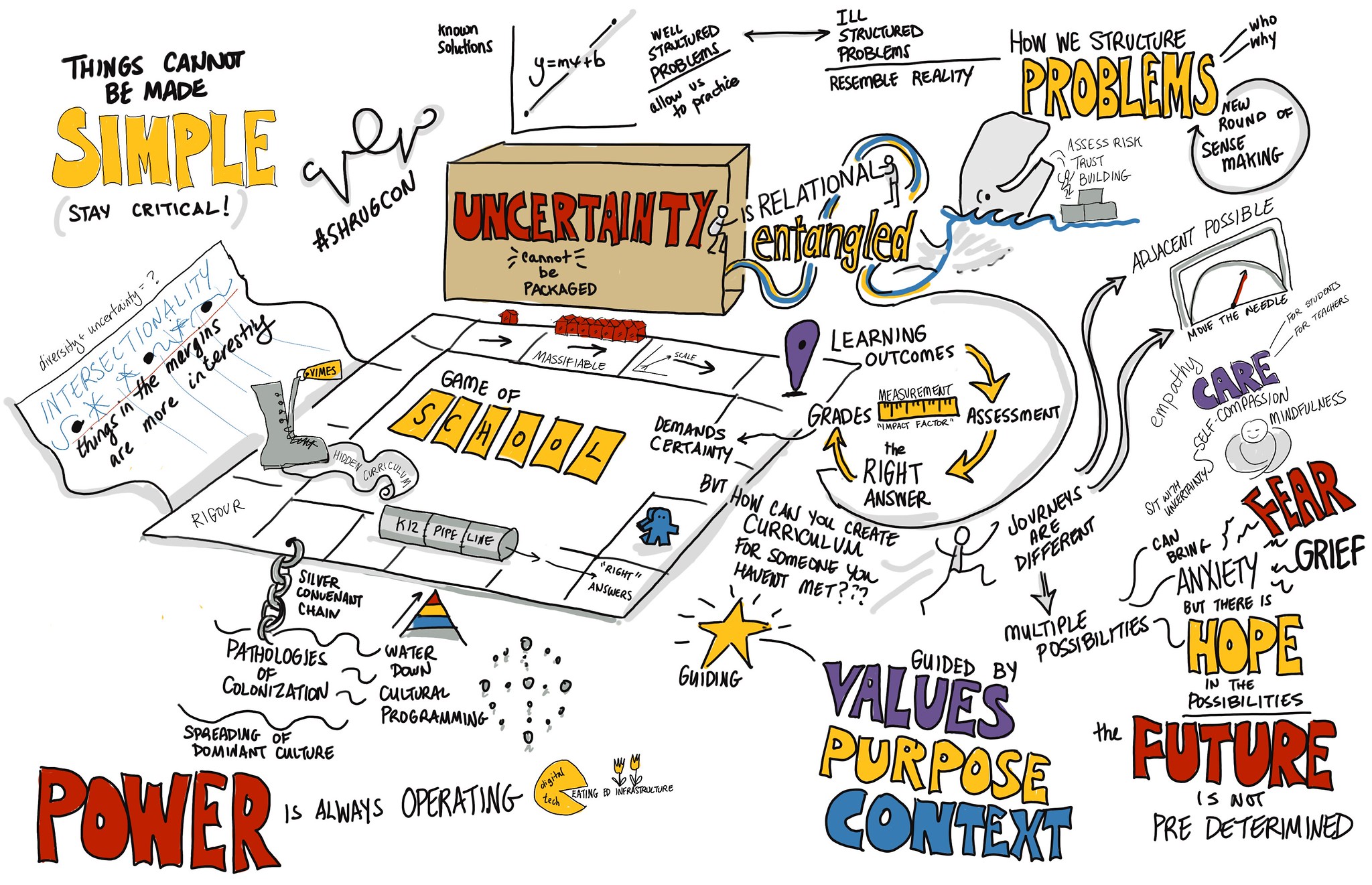
In the sidechat, we began to reflect on the power of emotional responses in mobilising us towards action. This came about as we listened to a story shared by Dr Kate Bowles about the experience of a mentee whose disrupted schooling meant they had to jump through additional hoops to apply to university, where they were met with bewildering indifference and incomprehensible redirection.
Our response, of course, was to feel. To feel indignity for this young person who deserved better, to feel anger at the university admissions system that treated them with systematic indifference. And it’s essential to feel our feelings — we can’t understand them if we suppress them, and worse, we can’t use them if we don’t understand them.
So this idea of “productive rage” began to proliferate in the discussion.
We talked about rage as motivating and potentially generative. The razor-sharp Lee Skallerup Bessette pointed out that rage has fueled most of her research and all of her activism. Another attendee noted that sometimes beneath the rage is grief, highlighting the implications of recognising and working with grief.
A lot more was said, and could be said. I’d love to have kept the conversation going. (My participation was stymied somewhat by the timezone issue — Mountain Time is 16 hours behind Melbourne Time — which was probably for the best given my tendency to dominate these things.)
This idea of productive rage resonates powerfully with me. It’s not a revolutionary idea: how we feel impacts what we think, what we believe, what we value, what we want, what we do. Rage, grief, anger, hurt, passion: each shapes orientation to action. Each has productive potential — and destructive.
In fact, there’s a good amount of research suggesting that without feeling, humans have difficulty making any decisions at all. This is visible in the impaired decision making of patients with brain injuries that have damaged their emotional processing. It’s visible in the astronauts who don’t want to eat in space because they can’t taste it. And of course, intrusive feelings (like chronic pain) can lead to shockingly poor choices and dangerous behaviour.
The question I think we have to ask is how can we channel these intense feelings towards hope, into productive rather than destructive work? This is similar to Daniel Goleman’s model of emotional intelligence: the idea that mastery of emotional awareness and management can translate into behavioural and performance success.
Of course, Goleman’s vision of professional productivity is typically invoked to help people achieve success within established systems. The discourse at ShrugCon was radical: how can we channel rage towards valued change? Negative affect can so easily cause us to turn from things that make us unhappy. We jerk away from a burning stove. We quit jobs we hate. And radicalised anger can lead to overt destruction, even terrorism. So channeling rage for positive transformation is no easy mission.
So Dave… what will we talk about at #ShrugCon2025?

 The Mind File
Leave a comment