
We know what is happening to the climate. But what can be done by people like us?
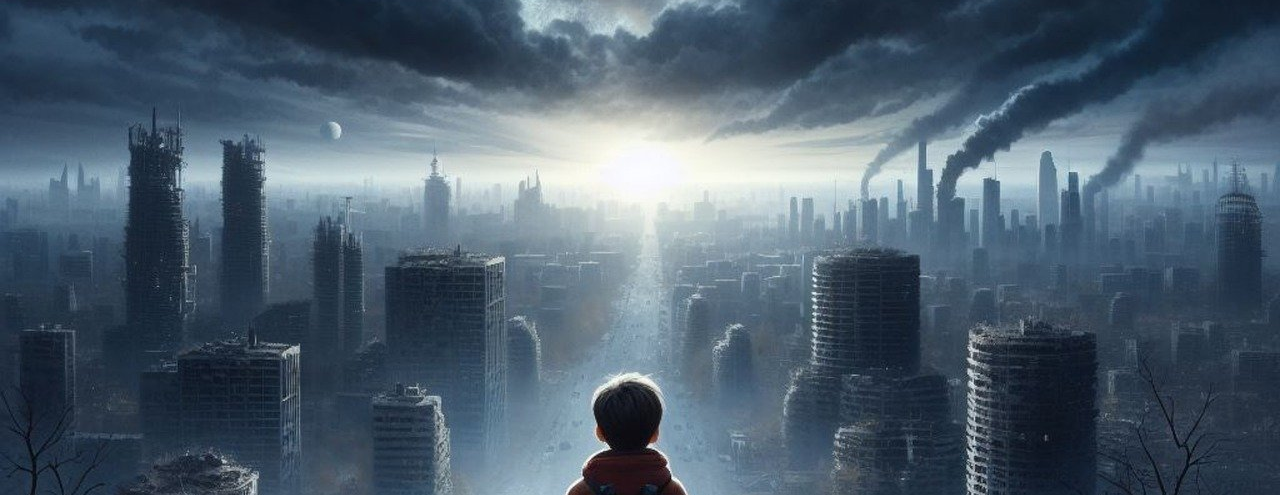
This year, I’ve been thinking hard about what kinds of initiatives might move people to take action on climate. We have lots of knowledge. We know that:
The planet is heating irreversibly and dangerously as a result of human industrial activity.1 2023 was the hottest year on record, seeing natural disasters on a global and catastrophic scale, and there’s an 86% chance we’ll beat that record again in the next five years.2
The global average temperature currently sits at 1.17°C above pre-industrial levels (defined as the average in the years between 1850—1900).3 The average in Australia is worse, at ~1.47°C.4
195 parties (countries, territories, etc.) have adopted the legally-binding Paris Agreement, agreeing to limit global warming to an average well below 2°C above pre-industrial levels, and aiming to limit that average to +1.5°C by the end of this century.5
But +2°C is a dangerously inadequate target and would lead to widespread, constant, uncontained natural disasters all over the world.6
And it’s really not looking good for +1.5°C. The global average temperature for the past 12 months was +1.63°C.7 Our progress remains off track on every indicator except sales of electric cars.8
Australia’s at higher risk than most. Even if we do manage to hold the global average warming to +1.5°C, the average warming in Australia will be at +2.1°C.9
It’s difficult to shake the sense of helplessness that comes with this. This information is so high level and so terrifying that it is extremely difficult to work with or even hold in my head.
What makes it even harder is that 1.5°C doesn’t actually sound like much, but we know how devastating it already is. 2°C would be catastrophic. 3°C, for many parts of the world, unlivable.
I’m not sure how to use this yet, but I think the only way of working forward with this is with hope in people. Not people like me — we just can’t afford to work or even think in isolation on this. People like us.10 People are the only chance the planet has right now of avoiding another extinction level event.
Because every decision to not cut emissions, to not use fossil fuels, to not reduce waste, to not regenerate natural resources, is made by people like us.
Who are people like us?
So this is the thing.
Think for a second who you are to other people in your life. Maybe you’re a parent, a manager, a sports teammate, a client. Don’t think about the things that just describe your occupations. I’m not interested in whether you’re a dancer, a loss adjuster or a game designer. Instead think about how, when you’re engaged in those occupations, you are related to other people. As a dancer are you might perform for audiences. Does that make you an entertainer to them? As a loss adjuster you provide a service for insurance customers. Does that make you a service provider to them?
People like us are lots of things to lots of groups of people. And each of these things we are is a sphere of influence that creates its own tiny upward pressure into broader spheres of power.
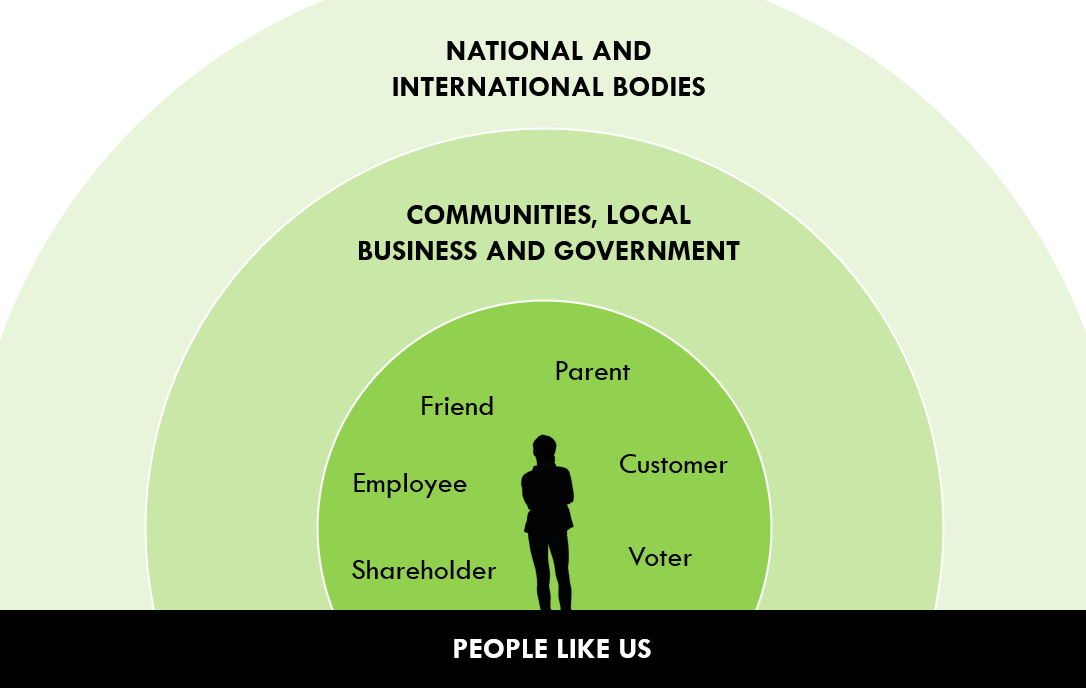
In each sphere of influence there are individual actions we can take. As a customer I can change my buying habits; as a small business leader I can set emissions reduction targets. But these actions can seem so insubstantial and insignificant in the face of the enormity of climate threat.
What starts to make a difference is when people like us do things like this. A customer can become customers. A business can be businesses. Various studies have found that sustainability behaviours are most commonly shirked when people just don’t feel as though it’s “something I would do”.
So how can we make these kinds of choices the choice for people like us?
UN Environment Programme (2023). Emissions Gap Report 2023.
NASA (2023). Global Temperature.
BOM (2022). State of the Climate 2022.
Climate Analytics (2022). Understanding the Paris Agreement’s Long Term Temperature Goal.
World Meteorological Organisation (June 2024). WMO Global Annual to Decadal Climate Update (2024-2028).
World Meteorological Organisation (June 2024). Global temperature is likely to exceed 1.5°C above pre-industrial level temporarily in next 5 years.
WRI (2023). Tracking climate action.
CSIRO (n.d.). Years at the +1.5°C global warming level.
I’ve stolen this from the title of my mother’s honours research. Thanks/sorry Mum!
 The Mind File
Leave a comment