
Let’s run Task Manager and see what background processes Sam Altman is running.
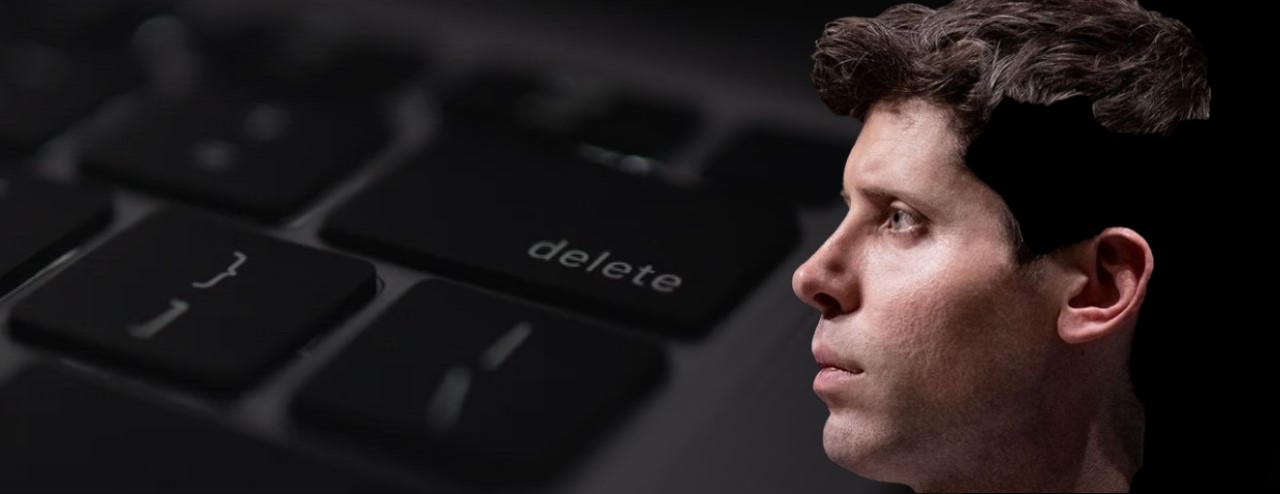
We need to be careful about people like Sam Altman.
He’s an ultra-wealthy crypto capitalist, college dropout entrepreneur, married gay man* and survivalist prepper. And he’s CEO of OpenAI, the hottest corporation on the planet right now, which fired him and was subsequently forced to reinstate him because shareholders kicked up a fuss. And now he’s ready to spend $50 billion a year in pursuit of Artificial General Intelligence.
*If this site had a readership, I’d be drawn and quartered for the gay bit – inevitable but deeply ironic given I am a married gay woman. But I do have a point to make here.
I’m not advocating personality politics, but it’s obviously worth reflecting good and hard on the implications of someone’s personal choices and attributes when we give them so much power over us. So, leaving aside the prepper bit, here’s why each of these things bothers me.
Cryptocurrency is an evil, planet-destroying scam.
Altman’s crypo project, “Worldcoin”, is purportedly a great democratic effort to give everyone “access to the global economy” by using a whopping great digital collection of all our retinal scans to verify our identities and enable trustless transactions via the blockchain. We already know blockchain technologies are environmental nightmare fuel, chewing up enormous energy and water resources and producing mountains of e-waste as crypto-miners push their insane computer systems to the brink in search of non-existent value tokens. We know they aren’t as decentralised or immutable as they claim to be. We know crypto has been legally banned in many jurisdictions. We still don’t know who authored the famed paper proclaiming the rise of bitcoin.
And now, Sam Altman wants to scan our eyeballs for a pocketful of digital change.
The college-dropout-prodigy is an insidious white male fantasy.
Altman began his career as a 19-year-old Stanford dropout who used USD $30 million in venture capital to found a Silicon Valley startup. Sounds familiar. This template of white techbro golden boy is stubbornly attractive, disguising privilege as providence while perpetuating a homogeneous mental model for shareholders of the profile of a “successful CEO”.
It’s not Altman’s fault he’s white, male and economically-privileged. Hey – he grew up gay in Missouri, too, so he’s not oblivious to prejudice. But it’s becoming a very sharp-edged pattern that should be worrying to anyone currently concerned about algorithmic bias or representational politics.
Gayness doesn’t mean the same thing to everyone.
I want to make clear that I’m talking here about my own (privileged) experience as a queer person, and I’m talking about potential dangers, not actualised ones.
Growing up gay was scary. I knew I was attracted to women before I’d finished primary school, and I was terrified someone would find out I was mentally ill. But once I became bold enough, I surreptitiously accessed queer communities online to find out if there was any kind of future for me. I found some kinship there amongst a lot of trauma, and began to build hope. I came out to friends slowly in my teens, and by Year 12 I was making speeches in English class at my middle-class high school about legalising same-sex marriage.
Altman’s experience, it seems, was similar. Three years my senior, he took early tentative steps in AOL chatrooms and by his graduating year he was boycotting anti-gay guest speakers at his high school.
Commendable? Of course. Challenging? Look – yes, but not as challenging as, say, the experience of my first girlfriend, who was beaten and thrown out of home by her own family; or the experience of Brandon Teena, whose gang rape and murder were the subject of the 1999 film Boys Don’t Cry.
The thing is that having a “different” identity only counts if the people around you aren’t the same as you. Altman (like me) is surrounded by people who are very much like him, and he minimises differences to keep it that way.
All of that is beyond my critique. I know when I’m standing in a glass house (and a very nice one too). All I want to point out is that when we choose the path of self-protection, it is all too easy to neglect the needs of those people for whom that path was never an option.
“I don’t know whether or not there is a glass ceiling for gay people in this field, but I do know that I decided right when I started out, I was never going to spend time thinking about that.”
This sounds inspirational in the same way as Sheryl Sandberg’s “lean in” rhetoric was inspirational to wealthy white career women. If you’re able to ignore the oppression, I’d suggest it’s because you’re not the target.
We really do need to pay attention to the personal beliefs, alignments and values of the people who have more power than national governments to shape our lives and futures. Altman speaks a lot about creating value and doing good in the world – but what does he think “good” looks like?
 The Mind File
Leave a comment