
Here I attempt to find a sincere position between humanist and posthumanist views of existence and inquiry.

One of my teachers yesterday made the important point that I will need to find a way to reconcile my humanist methodology (narrative inquiry) with the posthuman pedigree of ideas of sociomateriality, postdigital experience and social topology.
Or, in less jargony terms: in human storytelling we centre human expertise in describing and making sense of the world. But I’m studying the influence of digital environments on humans’ experience and sense of what matters. So my study can’t just assume that human storytellers hold the monopoly on making meaning.
I knew this but had been avoiding it or hoping it wouldn’t come up. I’ve been a little complacent, resting on my assumptions about what these worldviews mean.
Let’s try to redress that.
(Note: this article runs a bit long. It’s one of my “explanations to myself”, so I’m sounding out the ideas before smooshing them together.)
All right Miriam, what’s humanism?
Humanism came originally from philosophical work in, for example, Ancient Greece and China. The idea was innovative: that human reason could enable us to make sense of the world, rather than simply relying on religion and mythology. This wasn’t about disbelieving in gods, but about believing also in our own powers of truth-seeking.
As science and culture progressed, so did humanism: the scientific method was established to reify human reasoning as a tool for expanding knowledge; the humanities were founded to develop knowledge about human practice and society.
This had moral implications. Humans were the keepers of the keys, the only type of entity in the world with the potential and agency to determine what was good and do it. With such knowledge comes responsibility.
Today, humanism manifests in our societies in two particularly significant ways.
First, humanism led to the establishment of “human rights” which were debated over centuries before being made internationally explicit by the UN in 1948. By formalising human rights, we made possible the progression of rights for previously marginalised groups of humans.
Second, the legitimisation of atheism. Rather than defining atheist views as a negative stance (“there is no god”), humanism enabled atheists to state what they did believe in, based on evidence: human reason and agency. This has begun to powerfully displace the previous notion that morality is reliant on religion.
So concepts like democracy, freedom of speech, women’s rights, neurodiversity and child safety are humanist concepts. Nice, no?
But… so… why posthumanism?
Well, in very loose terms, movements beyond humanism are driven by the recognition that we are not the centre of the universe. We never were, but the more we learn about it, the more we have discovered we are somewhere astoundingly out in the periphery of the vastness of matter and non-human activity around us.
Remember Carl Sagan’s beautiful pale blue dot?
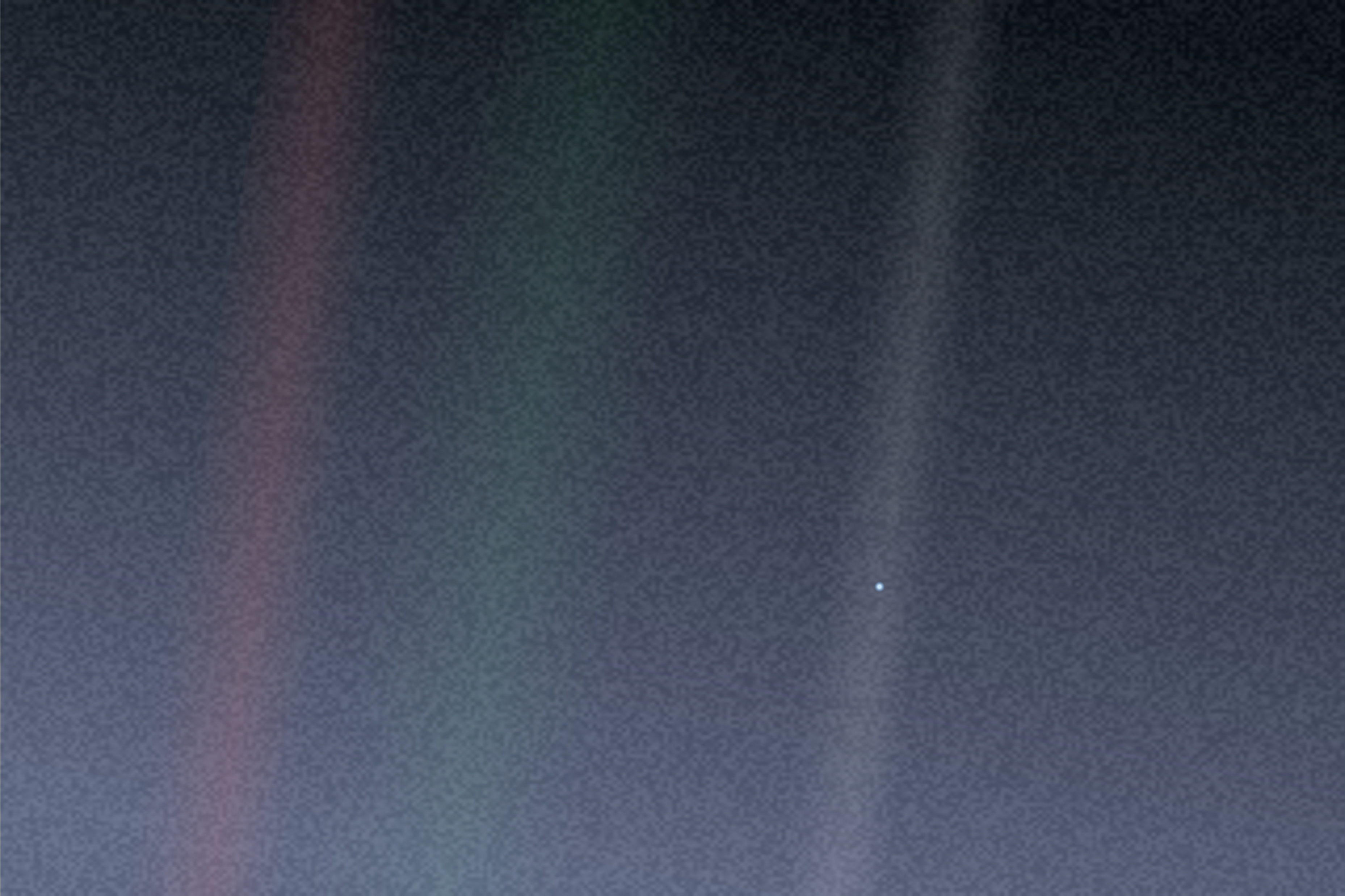
“Look again at that dot. That’s here. That’s home. That’s us. On it everyone you love, everyone you know, everyone you ever heard of, every human being who ever was, lived out their lives. The aggregate of our joy and suffering, thousands of confident religions, ideologies, and economic doctrines, every hunter and forager, every hero and coward, every creator and destroyer of civilization, every king and peasant, every young couple in love, every mother and father, hopeful child, inventor and explorer, every teacher of morals, every corrupt politician, every ‘superstar,’ every ‘supreme leader,’ every saint and sinner in the history of our species lived there—on a mote of dust suspended in a sunbeam.”
Posthuman scholars belong to a range of camps, including new materialism, transhumanism, and non-technological humanism among so many others. Depending on your posthuman positioning, you might focus on, for example:
developing a revised ethics in acknowledgement of more-than-human entities, such as non-human animals and nature
the inextricable entanglement of human actors with material objects (whether physical, biological, digital, or otherwise mattering somehow to what we do and how we do it)
questions of personhood and rights, such as whether an AI could be considered a person
the potential for humans to transcend their current biological constraints through technology (say, radical increases in lifespan, bionic body parts or genetic engineering).
The sociomaterial positioning of postidigital experience (my research space) is posthumanist. It calls for a focus not on The Technology and The Person, but the relations between them.
And where does that leave you?
Well, I’m holding a view of human-centred sensemaking (narrative inquiry) in one hand and an imperative to acknowledge entanglement with the material in the other. Which is awkward.
But I think there is space to acknowledge the inevitable influence of the material on human sensemaking while still holding that human sensemaking is a worthwhile endeavour. There are some headscratching applications of posthuman inquiry out there, like this interview with an iPod Touch. And while I, as an extreme novice, cannot fairly critique this work, I certainly can’t yet make sense of it either. But I can judge that despite being an effort to centre the material, it remains a human sensemaking endeavour and the knowledge it has produced is for the use of humans.
I do not say “for the benefit of humans” because to me, where humanism has taken us means we must decentre ourselves as the beneficiaries of our efforts. Through reason and inquiry we know – and cannot unknow – that there are other parts of our world worth attending to. The posthuman turn is a response to this knowing, and a call to know more in new ways, and a readiness to embrace complexity.
It’s not all great stuff. Some posthumanists are still centring humanity: transhuman dreams of functional immortality are all about feathering our own nests. Other posthumanists elevate the agency of objects, thus diminishing the perceived power (and, by extension, responsibility) of human actors.
But the fundamental acknowledgement that more is out there (and in here) is to me a call to responsibility. It’s a call to own our power, recognising its limits and interdependencies, and use the knowledge we have to honour the world we know. I’m obviously not the first to suggest this – here’s a paper from two archeological researchers stating a valued position between humanism and posthumanism in the study of human artefacts.
And there’s old Carl Sagan, of course.
Sagan positioned himself as a secular humanist, but his words sit somewhere between humanism and posthumanism. Using scientific framing, he decentres humans in the universe, showing how obscure and tiny are our lives and our world within a great expanse of space, across staggering distance (that Voyager 1 photo was taken from 6.4 billion kilometres away) and amongst a truly vast number of other worlds.
And yet his message is punctuated with a call to responsibility and to focus on our scope of reach:
“It has been said that astronomy is a humbling and character-building experience. There is perhaps no better demonstration of the folly of human conceits than this distant image of our tiny world. To me, it underscores our responsibility to deal more kindly with one another, and to preserve and cherish the pale blue dot, the only home we’ve ever known.”
Earth, this tiny, frail pixel in a 34-year-old digital photograph, has made possible a magnificent proliferation of life for us. All our frenzied activities taken without regard for it are nonetheless entirely by its grace. The Earth is not all there is; what we know is not all that can be known. But this for now is all we know and all we have – so we have a duty to it, as well as to each other.
Right, and where does that leave your research?
Fundamentally, I believe narrative inquiry can and should be updated for a posthuman era.
Its core aim is to capture and interpret human life experiences in the form of cohesive narratives. Its constructivist worldview holds that experiential knowledge is constructed by the experiencing person, and undergoes continual reconstruction as it is told and retold. It typically employs interview methods to gather accounts of experience, and draws on a three-dimensional framework of sociality, temporality and place to build experiential context.
This framework is ripe for welcoming more-than-human elements and relations into the storytelling environment. When reading my overview of it, my supervisor actually mistook it for a nod to social topologies. Stories are not seeded or harvested in isolation – they are accounts of human interactions with other humans, with themselves, and with things in their worlds, in time, relayed in contexts of speaking, writing, recording, drawing or otherwise communicating with a present or potential audience. The expected listener is almost certainly a human, even if it is themselves; but the telling is always mediated by more-than-human entities.
So then how might the storytelling environment in a narrative interview create space for such entanglements? This, I think, is my challenge – and it’s a fun one.
 The Mind File
Leave a comment