
An exploration of Peter Jarvis’s key claims about experience. He developed a coherent argument about what learning experiences are and how they relate to the construction of selves and biographies.

Learning as disjuncture
“Experiences … occur at the intersection of individuals’ inner life-world with the wider social or empirical world and when they are unable to take the external world for granted and act in an almost unthinking manner. It is this that I have called disjuncture and it is the point at which learning begins.”
Jarvis, 2007
Jarvis proposed that learning is catalysed by a state of disjuncture between a person’s internal world and the wider social or empirical world. When the two cannot be reconciled – when the person can no longer draw on their internal resources to make sense of their external experience – then disjuncture is created and learning can occur.
For Jarvis, experience comes in two forms – primary experience being sensory and direct, while secondary experience is an abstraction of primary experience transmitted through information and data. (So a primary experience might be a personal encounter with an echidna, while a secondary experience might involve reading a book about them).
Other theories of educational experience I have explored (with a particular nod to the ideas of Dewey, Heidegger and Peirce as analysed by my excellent supervisor John Quay) tend to articulate a similar form of segmentation and flow from immediate, pre-cognitive experiential input through successive layers of abstraction and personal interpretation. This is a very rough rendition of this flow, which really doesn’t do justice to the theorists mentioned above:
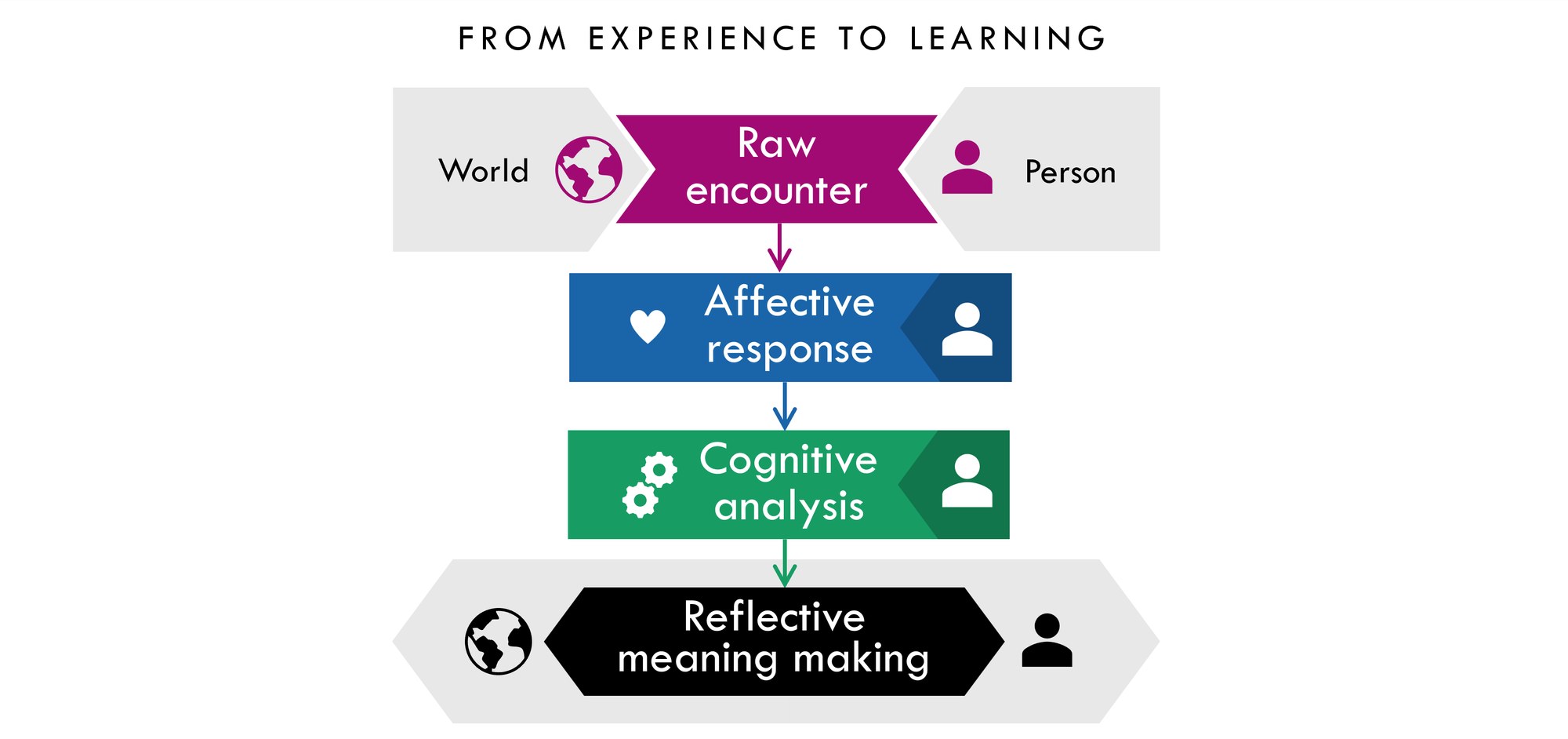
If a raw encounter with the world creates an affective or cognitive disjuncture, the person becomes open to the possibility of reflection and of constructing new meaning.
The process of reflective meaning making has a dual impact outward on the parties to the encounter. The person, having learned something new about the world, has an altered worldview. The world as constructed by that person has also changed, and all future encounters between them are now charged with a new set of possible responses.
Learning as biographical
“The outcome of every learning experience is that it is incorporated into our identities: through our learning we are creating our biographies. We are continually becoming…”
Jarvis, 2007
It was Jarvis’s writing that first introduced me to the relationship between learning and the writing of one’s biography. He posited that each genuine learning experience contributes to creating the learner’s identity. He wrote that identity is “constructed as a result of our being and acting and from our learning”, and thus that the actual construction of the learner self is an output of learning experience.
This suggests that Jarvis, like me, was a social constructionist: he viewed social reality as something people create through our encounters, interactions and expressions. This position rejects the view that there is one objective reality that we can know; instead each of us creates our own reality and attempts to negotiate it through our interactions with others in our social worlds.
On a slight tangent from Jarvis here, this thread about biography put me onto Wolff-Michael Roth who claims that each autobiography is at the same time a story of the self and a story of the “generalised other” – that is, by articulating who we are, we distinguish ourselves from who and what we are not. I think this builds beautifully on the notion of person and world emerging changed from each learning experience. As a learner’s knowledge of their world grows and transforms, the auto/biography (Wolff’s term) becomes a richer story about self and other.
Learning as event, episode, experience
“… experience is a sequence of events that overlap and form a continuous whole and yet, like biography, it is a single episode in our lives.”
Jarvis, 2009
Jarvis distinguished between temporal categories of “event” and “episode”, offering these as cognitive building blocks of “experience”. His writing on this subject evokes John Dewey’s educational experience criterion of “continuity”: that the learner perceives relationships between the experience and what comes before and after it.
Jarvis suggested that an event could be conceived as a specific moment in which particular circumstances are established – the here-and-now – which alone present a set of conditions such as those a scientist might wish to isolate, or which a film set designer might assemble for a single scene. For example, two people sit together in a room with a bowl of caramels before them.
An episode, by contrast, would encompass a continuous stream of such events which are “bound together in a continuing awareness”. The events within an episode might be linear, simultaneous or overlapping: the day that the caramels were placed in the room, the eating of the caramels while holding a conversation, the interruption of the conversation as others came in because they heard there were treats in the room, the next week when the bowl was instead filled with corporate mints. Episodes within our lives hold together through their continuity of meaning. So, in the language of education, a “course of study” might be an episode of one hour, four weeks, six months, three years.
Both the event and the episode are experiences. For Jarvis, there were two areas of critical concern: the way these experiences are linked together to form a coherent flow (either in the moment or in retrospect), and the points of disjuncture which interrupt this flow and invite the possibility of learning.
All of these ideas lead me to the power of narrative in constructing meaning and biography in order to make some sense of educational experience.
References
Dewey, J. (1938). Experience And Education. Macmillan.
Jarvis, P. (2011). Teaching, Learning and Education in Late Modernity: The Selected Works of Peter Jarvis. Taylor & Francis Group.
Jarvis, P. (2009). Experience. Learning to Be a Person in Society. Routledge, 55–68.
Jarvis, P. (2007). The Spiritual Dimension of Human Learning, in R. Mark et al. (eds), Proceedings of SCUTREA Conference, Belfast, 238– 45.
Quay, J. (2013). Education, Experience and Existence: Engaging Dewey, Peirce and Heidegger. Routledge.
 The Mind File
Leave a comment